

Anticipate. Position. Advance. Multiply.
This Is What Sales Winners Do


Sales enablement has never been better funded. It has never been more sophisticated. And across the industry, adoption remains stubbornly low.
The gap is not effort. Most enablement teams are doing excellent work. The gap is design.
Organizations produce more content, more training, more decks, and more learning paths than ever before. Sellers attend sessions. They complete modules. They check boxes. Then they return to their deals and do exactly what they did before.
This is not a failure of the learner. It is a predictable outcome when enablement is designed as an event rather than a system.
When you study how top performers actually operate in complex deals, their behavior follows a repeatable pattern. Not because they were trained on it, but because it works under pressure.
That pattern is simple.
Anticipate. Position. Advance. Multiply.
The Center of the System
Execution Is the Only Outcome That Matters
Winners do not confuse activity with progress.
They do not measure success by what was delivered, completed, or consumed. They measure it by what changed in a live deal.
If nothing changes in the deal, nothing happened.
Learning science has been remarkably consistent on this point. Exposure alone does not change behavior. Without reinforcement and application, new information decays rapidly; often within days. The forgetting curve, first documented by Ebbinghaus and validated repeatedly across decades of research, shows that most learning fades quickly regardless of how strong it felt at the time.
This system starts with that assumption and works outward.
Anticipate
Winners See the Deal Before It Fully Forms
Top performers do not wait for deals to declare themselves. They recognize patterns early.
They sense where a conversation is heading. They notice when a customer is stuck. They see inflection points before others do.
This is not intuition. It is pattern recognition built from experience.
The difference between average and elite execution often comes down to this. One group reacts. The other anticipates.
Research on learning versus performance shows that people often mistake short-term clarity for long-term learning. Something can feel clear in the moment and still fail to show up later, when it actually matters. Enablement succeeds when it sharpens recognition, not just comprehension.
If you cannot anticipate what is happening in the deal, you are already behind it.
Position
Winners Control the Narrative
Seeing the situation is only the beginning.
Winners shape how the situation is understood. They choose the language. They frame the problem. They define what matters and what does not.
This is where most deals are won or lost.
When sellers struggle here, it is rarely because they lack knowledge. It is because they lack language they trust under pressure.
Research on retrieval practice shows that actively recalling information dramatically improves long-term retention. Saying something out loud strengthens memory more than passively consuming content. Elite performers use simple, repeatable framing. Not jargon. Not slides. Words that work in live conversations with customers, partners, and internal teams.
They do not explain more. They explain better.
If you do not position the deal, someone else will.
Advance
Winners Create Motion, Not Activity
This is where execution becomes visible.
Winners do not confuse motion with meetings. They do not confuse progress with participation.
They take actions that change trajectory.
Every advance is deliberate. It is tied to a moment in the deal. It is designed to move something forward: a decision, a commitment, a next step that matters.
Learning research shows that knowing something is not the same as doing something. In fact, techniques that feel harder in the moment often produce stronger long-term learning and transfer. The shift from understanding to action is where most enablement collapses. Too many ideas. Too many options. No clear next move.
Winners simplify. One move. At the right time.
If the next step does not change the deal, it is not a step forward.
Multiply
Winners Turn Success Into Advantage
Winning once is skill. Winning repeatedly is system.
What separates top performers is not that they win. It is that they reuse what works and compound it over time.
They revisit successful patterns. They sharpen language that landed. They repeat actions that moved deals forward.
This is not repetition for its own sake. It is leverage.
Spacing and repetition are among the most robust findings in all of cognitive psychology. Distributed reinforcement over time consistently outperforms one-time exposure across tasks, domains, and learner types. Manager involvement matters here as well. Research shows that when leaders reinforce learning in context, application and retention increase materially.
Without this step, performance resets to baseline. With it, success compounds.
Winners do not rely on memory. They rely on systems that keep what works alive.
What Sellers Actually See
The Gap Between Design and Delivery
Everything above is grounded in research. It is how we design enablement systems.
But we would never put this framework in front of a seller.
Not because it is wrong. Because it is too abstract. Sellers do not need to understand the methodology. They need language that works in the moment, under pressure, without translation.
So when we build field-facing materials, the framework shifts.
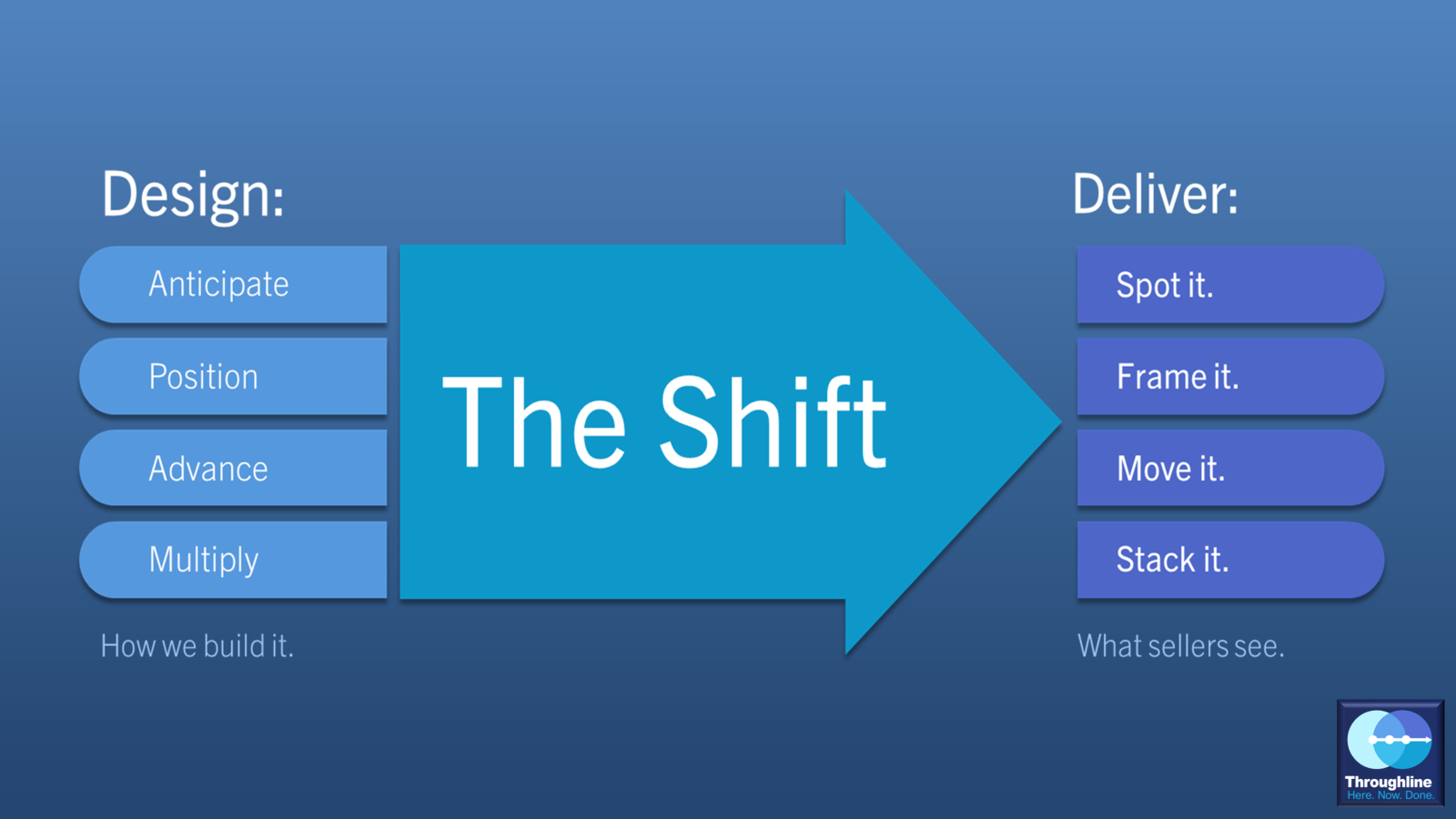
Anticipate becomes Spot It. Read the situation early.
Position becomes Frame It. Control the conversation.
Advance becomes Move It. One action that changes trajectory.
Multiply becomes Stack It. Build on wins instead of starting over.
Same system. Different language. The research shapes the structure. The field language drives adoption.
Here is the test we use: if a seller cannot absorb a concept in 10 to 17 seconds, it will not survive the field. That is not a guess. It is a design constraint. Every play card, every talk track, every coaching prompt gets pressure-tested against that window.
Most enablement fails because it optimizes for completeness. Effective enablement optimizes for absorption.
Sellers do not need to understand why the system works. They need the system to work for them.

Why This Matters More in Partner Ecosystems
I wrote recently about a collision happening in enterprise buying. Self-serve research is accelerating at the same time solutions require more partners, not fewer. Buyers want to figure it out alone. But the solutions they need require coordinated ecosystems: infrastructure, software, services, integration.
This creates the core tension.
When three partners publish three different stories, the buyer does not reconcile them. They simplify. They cut someone out. Or they choose a competitor whose story was easier to understand.
I call this the alignment tax: revenue you never see because your ecosystem was too hard to understand. It rarely shows up in the CRM as “lost due to ecosystem confusion.” It hides behind codes like “no decision,” “went with competitor,” or “deal slipped.”
The 10 to 17 second test applies here too.
If a seller cannot absorb a concept in that window, it will not survive the field. The same principle that makes seller enablement work applies to ecosystems. If buyers researching at midnight cannot absorb your joint value quickly, they will design around the confusion and move forward without the partner.
Ecosystem clarity is no longer a nice-to-have. It is a competitive surface. The battle happens before the first conversation.
Organizations that get this right will close deals that competitors lose to confusion. They will win because customers arrived with correct assumptions instead of flawed architectures. They will earn confidence that competitors cannot replicate because they made the complex feel simple before anyone got a meeting.
Why This System Works in the Real World
This model survives reality because it is built for it.
Deals are messy. Time is scarce. Partners add complexity. Attention is fragmented.
A system built around anticipation, positioning, advancement, and multiplication aligns with how high performers actually operate under pressure.
It works across new logo pursuits, expansion and attach motions, co-sell environments, and partner-led deals.
And it applies equally to sellers, presales, partners, and the leaders responsible for scaling execution.
What This Means for Leaders
If you lead sales, alliances, or enablement, the questions shift:
Where can we help teams spot patterns earlier?
How well do we equip them to frame deals clearly?
Do our actions actually move deals forward?
What are we stacking, if anything?
And critically: can a buyer researching your ecosystem at midnight understand the joint value without talking to anyone?
The shift is not from bad enablement to good enablement. It is from delivery to execution design.
The Takeaway
Most enablement delivers content. Winners operate with a system.
The design layer matters: Anticipate. Position. Advance. Multiply.
The field layer matters more: Spot it. Frame it. Move it. Stack it.
And in a world where buyers form opinions before sellers get in the room, ecosystem clarity is no longer optional. It is how you win deals you never knew you were losing.
Enablement designed around these behaviors does not just survive the field. It scales.
_______________
Research Sources
Ebbinghaus, H. Memory: A Contribution to Experimental Psychology. psychclassics.yorku.ca
Soderstrom, N. C. & Bjork, R. A. Learning versus performance: An integrative review. Perspectives on Psychological Science
Roediger, H. L. & Karpicke, J. D. Test-enhanced learning: Taking memory tests improves long-term retention. Psychological Science
Bjork, E. L. & Bjork, R. A. Making things hard on yourself, but in a good way: Creating desirable difficulties to enhance learning. UCLA Bjork Learning and Forgetting Lab
Cepeda, N. J. et al. Distributed practice in verbal recall tasks: A review and quantitative synthesis. Psychological Bulletin
McKinsey & Company. Building capabilities for performance. mckinsey.com
Forrester. B2B Marketing & Sales Predictions 2025. forrester.com
_______________
Scott Sherman is the founder of ThroughlineHND, where he helps technology companies turn partner strategy into field execution. Before founding ThroughlineHND, he led global partnership enablement at Dell Technologies, building navigation and activation systems that drove measurable seller adoption and partner attach rates across enterprise sales teams.