

Shifting to AI+
Closing the gap between investment and performance.

I wrote recently about why chat engines are necessary but not sufficient. The response told me I hit a nerve.
This article is about what comes next.

What We’re Solving For
The Productivity Gap
You invested in AI-powered knowledge systems. You projected 20-30% sales productivity gains. You’re capturing maybe half of that.
The gap isn’t in your chat engine. It’s in two layers most organizations haven’t built.
Here’s the full stack:

Many organizations are investing in Layer 2. That is the right call; it is solving a real problem. But Layer 2 alone delivers roughly 60% of the projected value. The remaining productivity lives in Layers 1 and 3.
Some Background
What Layer 2 is Solving: For decades, getting an answer meant knowing who to call. The senior engineer. The partner specialist who’d been around since 2015. Chat engines changed that. A seller can now ask a question in plain language and get a synthesized answer from across the organization. That’s transformational. The foundation is real.
What Layer 1 Requires: A chat engine is only as good as what you feed it. Most organizations trained their AI on 60-slide decks and 12-page briefs; content that was never designed to be absorbed in the moment a seller needs it. The fix: content built for the 10-17 second rule. I covered this in depth in the article “Anticipate. Position. Advance. Multiply.” and the companion YouTube video on “Spot It. Frame It. Move It. Stack It.”
Layer 1 matters. But most organizations understand they need better content. The harder problem is Layer 3.
What’s Really Needed Next: AI+
Layer 3: The Problem - A Navigation Gap
Even with well-designed content, sellers still get stuck at a specific moment: when they don’t know what to do next.
You don’t always have a search query. Sometimes you have a situation. And situations don’t fit in search bars.
The chat engine answers “What do we have?”
It doesn’t answer “What should I do?”
That requires a different layer.
Layer 3: The Solution - Decision Guides
A Decision Guide starts with a different question: What are you seeing?
Not “what are you searching for.” What are you observing in the deal, in the customer, in the conversation?
From there, it branches based on the situation. Each branch leads to either another diagnostic question or a specific action.
Decision Guides do two things chat engines don’t:
They make good content sticky. Instead of retrieving information once and hoping sellers remember it, Decision Guides surface the right content at the right moment, triggered by the situation.
They’re navigable on demand. When sellers are stuck, they don’t formulate a search query. They answer a question about what they’re seeing, and the system guides them forward.
What This Looks Like
Here’s a radically simplified example for AI infrastructure partner plays:
Question 1: What’s driving the AI conversation?
Options: Cost pressure | Data control | Performance requirements
Question 2: Where are they running workloads today?
Options: On-prem | Cloud | Hybrid
Two questions. Under two minutes. One clear path forward.
Output example for “Data control + On-prem”:
Recommended Play: Private AI Inference at the Edge
Framing: “You need inference close to your data, with latency and compliance control that cloud can’t always provide. We’ve packaged a solution that delivers cloud-like agility in your own data center.”
Next Action: Schedule 30-minute workload assessment. Use the Edge AI Discovery template.
The play card is designed for absorption. The Decision Guide makes it navigable. The chat engine handles follow-up questions. All three layers working together.
Why This Matters More in Partner Ecosystems
I’ve written before about the Alignment Tax: revenue you never see because your partner ecosystem was too hard to understand.
This AI+ full stack is how you stop paying that tax.
A typical enterprise technology company has 50-200 partners. A typical seller understands maybe three. That’s not a training problem. That’s a navigation problem.
With all three layers, sellers navigate partner complexity without becoming experts in every partnership. They answer a few questions about what they’re seeing, and the system guides them to the right configuration.
Pattern recognition becomes repeatable. Tribal knowledge becomes scalable. Ecosystem complexity becomes competitive advantage.
For Partner Account Teams, this is how you scale. Instead of fielding the same “Should I bring in [Partner] on this deal?” question from 600 sellers, you encode your expertise into a path they can navigate themselves. Sellers become self-sufficient on partner engagement. You get time back for strategic relationship work.
The Test
Pick a seller 12-18 months into the role. Give them this scenario:
“Your customer is evaluating AI infrastructure. Data sovereignty concerns, existing data center, real-time inference needs. You have 30 minutes. Figure out the right partner play.”
If they search and get useful, deployable answers: Layers 1 and 2 working.
If they answer two questions and get guided to the exact play in under two minutes: All three layers. Full productivity captured.
If they call their manager or their PAM: You have a dependency that doesn’t scale.
What We Build
This is the work we do at ThroughlineHND.
Layer 1: Enablement content designed for absorption. Play cards, talk tracks, recognition prompts. Materials that make your chat engine more valuable.
Layer 2: We honor your investment. We design content that feeds it well and then layer decision guides and proactive micro-learnings on top.
Layer 3: Decision Guides that make content sticky and navigable. This layer turns retrieval into action.
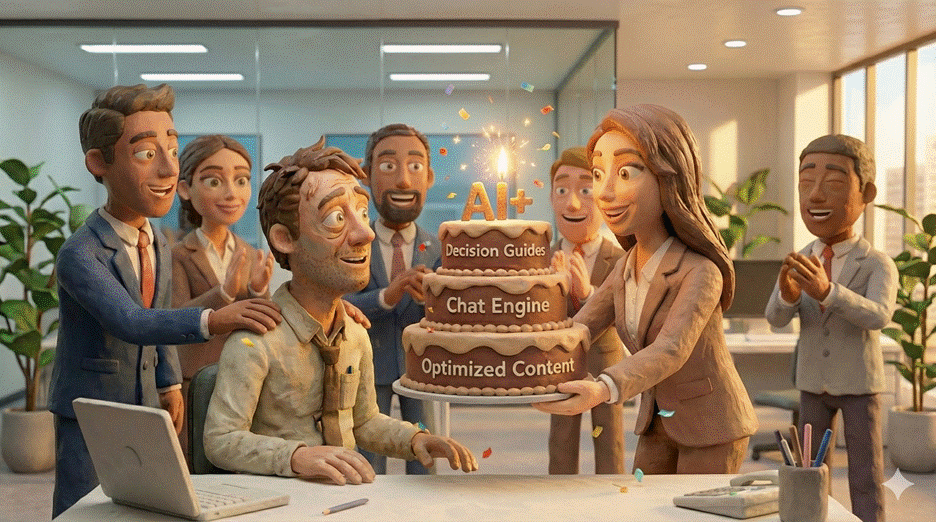
The Decision Guides we build include constraint pickers, industry overlays, and situation-based branching; all designed to prescriptively guide sellers to the right asset (micro videos, talk tracks, discovery cards) at the right moment, based on what they are experiencing. We design decision guides to augment chat engines so sellers can act, not just search.
“Enablement should help sellers decide, not remember.”
Building Layers 1 and 3 requires field-tested iteration. Content designed at a desk rarely survives first contact with a real seller; it needs refinement from actual deal feedback over 60-90 days. That’s the capacity most teams don’t have while protecting the quarter.
Chat engines answer “What do we have?” We build the layers that answer “What should I do?”
Scott Sherman is the founder of ThroughlineHND. Before ThroughlineHND, he led global partnership enablement at a Fortune 50 technology company, building navigation and activation systems that drove measurable seller adoption and partner attach rates.
This article is Part 3 in a series. Start with “Chat Engines Are Necessary. They’re Not Sufficient.” and “Anticipate. Position. Advance. Multiply.”